Jaishankar said that the situation in the region has now stabilised and lots of restrictions have been rolled back including the operationalising of landlines and mobile towers and resumption of economic activity.

The Indian Army, the Border Security Force, Hindu temples and the people of India, all have been targetted by fidayeen from Pakistan.
Modi said his government's focus was on adopting the strategy of 'Reform, Perform and Transform'.

'When you think back to the promises made 10 years ago, not a single one of those had panned out to date.'

Since multilateral trade creates a stable, peaceful world, normalisation of bilateral trade between India and Pakistan will start a series of peace building measures, especially along the bordering areas of both states which is the worst affected from the on-going conflict, say Riya Sinha and Shehzad Poonawalla.

A single party will need at least 137 of the directly elected seats to be able to form the government on its own.
Composite dialogue likely to be formally revived; PM visit might also be marked with grant of trade MFN status. Nayanima Basu reports

'If only Cariappa/Thimayya/Chaudhari/Manekshaw were given a free hand, there'll be no PoK, the Chinese would have been taught a lesson, 1965 would have slain the Pak demon and in 1971 just another fortnight's fighting after Bangladesh and West Pakistan would have been occupied.' 'No authoritative military account suggests anything remotely like any of these...' '...Chronologies, names, even periods get mixed up, but, never mind, because the point -- strong Army denied by cowardly Congress -- is made.' 'This is where Modi is coming from,' points out Shekhar Gupta.

Counting has begun for the election which will be the second democratic transition of power in the nation's 70-year history.

"The RSS is trying to change the nature of India. Other parties haven't tried to capture India's institutions," he said.
If he doesn't, two things are guaranteed: Failure for him, and continued slide for his nation despite its talented people, strong nationalism, the gift of geography and a formidable army, points out Shekhar Gupta.

Congress General Secretary Digvijay Singh on Thursday said Shashi Tharoor, who was eased out as party spokesman for praising Prime Minister Narendra Modi, still enjoys a high-level of confidence among the partymen.

"India has no knowledge of Kulbhushan Jadhav's location and his condition. We are making all efforts to get him back but we can't reveal the steps that will be taken to achieve it," the MEA said.

Prime Minister Narendra Modi on Sunday said he would be receiving family members of Subhash Chandra Bose next month but avoided any reference to declassification of secret files related to him which is being demanded by various sections after West Bengal government did so.
'Jihadi outfits backed by the ISI are now prepared to attack targets not just in J&K, but also in Punjab. This signals an escalation in the range and scope of cross-border terrorism, which cannot be ignored,' says Ambassador G Parthasarthy, former high commissioner to Pakistan.

To persist with talks in the face of continuing terrorism that puts hundreds of Indian lives at stake is not only naive but morally repugnant and ethically unacceptable. It is time to see through this charade and abandon a path of high risk and no returns, says Vivek Gumaste.
US Assistant Secretary of State for South and Central Asia Nisha Desai Biswal believes the India-US nuclear deal is not in limbo and it is for India and Pakistan to set the pace for conversations to resolve their issues. Rediff.com's Aziz Haniffa reports from Washington, DC.

A look at the top tweets from your favourite Bollywood celebrities.
"The timing of the attack, methodology and location are all eerily similar to attacks in the border belt of Jammu," said Abdullah.
All Indian prime ministers must know that the route to their Nobel Peace Prize doesn't go through Pakistan, says Rajeev Sharma.

Indian security agencies in possession of telephone bill, passport details that the underworld don lives in a upscale Karachi locality, reports The Hindustan Times

The political resolution passed at the party's national executive claimed that the Modi government has created a new "history" in the direction of the poor's welfare with its bold initiatives.

'It has a natural inclination to foster as much competition among civilian politicians as possible.'

General Qamar Bajwa, his colleagues say, is a firm opponent of extremism and terrorism. He may prove even more forceful in the fight against terrorism than his predecessor, who is credited with launching Operation Zarb-i-Azb, which helped lower the frequency of terrorist attacks.

The strategic success of the surgical strikes has not matched their brilliant tactical achievement, says Shekhar Gupta.

India has built two top-secret facilities in Karnataka to enrich uranium in pursuit of its hydrogen bomb dream.
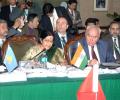
'The truly amazing part is the influence that Washington wields over Modi and the Sangh Parivar,' says M K Bhadrakumar. 'What explains it? The Americans know precisely well which raw nerve to touch and how to make the Sangh Parivar, Modi and this government perform the trapeze act.'

20 years ago this day, May 11, 1998, India conducted its second nuclear test at Pokharan in Rajasthan. In a fascinating interview on Rediff.com, K Subrahmanyam revealed how Indian PMs reacted to nuclear ambitions.
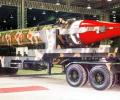
For the world and India, one of the most enduring challenges of the times is for Pakistan's nukes to be neutralised, before they are ever used by the State, their sponsored non-State actors or any rogue elements from the many terror tanzeems dotting Pakistan's unstable landscape, says Lieutenant General Kamal Davar (retd).

The two were convicted on July 6 in the Avenfield properties case linked to the Sharif family's ownership of four luxury flats in London.
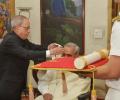
Former PM Atal Bihari Vajpayee was on Friday conferred with the Bharat Ratna.

'There is a consensus within the Indian security establishment -- at least among those who draw their conclusions from data instead of speaking from nationalist sentiment -- that India lacks the offensive capability to defeat Pakistan in a short war.'
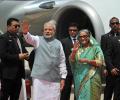
'When we have a terrorist outfit in a neighbouring nation, we need to do whatever we can to neutralise that threat,' says Ramananda Sengupta.

Taking a swipe at the prime minister, Shinde said Modi used to say that UPA ministers were serving biryani to Pakistani leaders but what is happening now.

'The Modi regime, after experimenting with its own versions of neighbourhood policy for 18 months, has now reached the exact stage where the Manmohan Singh government had left it in so far as our Pakistan policy is concerned,' says former senior RA&W officer Vappala Balachandran.

'All this talk of 'tactical nuclear weapons' or a limited nuclear war are 'false flags'! It looks like India and Pakistan are slowly but surely inching towards this realism,' says Colonel Anil A Athale (retd).

'India alone cannot walk the path of peace. It also has to be Pakistan's journey to make,' says Prime Minister Narendra Modi at the government's geo-political flagship initiative "Raisina Dialogue-II".

A grieving Pakistan's policy shift towards the Taliban has comes at a great cost, says Shahzad Raza.
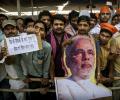
'Modi's victory is his own victory. Now what he has done thereafter, it seems to me, leads us to believe that he was a bit too prolific with his promises.' 'One achievement of Modi's I will praise is that he has put the fear of God among his ministers and officials.' 'Indira Gandhi's sentiment of controlling everything, centralising power in to her hands is the quality that persists in Modi' Veteran journalist Inder Malhotra casts his experienced gaze on one year of the Modi Sarkar.
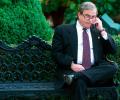
'In his eulogy at Sandy's memorial service, President Clinton recounted the unusually hot US Independence Day, July 4, 1999, when most of official Washington was more interested in watching fireworks than international diplomacy. Sandy insisted that Clinton confront Pakistan Prime Minister Nawaz Sharif in no uncertain terms.' Former US Assistant Secretary Raymond E Vickery, Jr salutes Sandy Berger, Clinton's National Security Adviser, as a true friend of India.
